Research program · Brigham and Women's Hospital · Harvard Medical School
From molecular interventions to system-level responses.
I develop AI methods that learn how a molecular intervention—a small molecule binding a protein or RNA—reshapes interactions, networks, cellular states, and ultimately phenotype, and I hold every model to one standard: it has to be trustworthy.
Core question
How does a molecular intervention propagate across biological scales?
Most biological AI models live within a single scale: a binding affinity, a modification site, a cell type. Living systems are coupled across scales, and the quantity that matters clinically is the response of the whole system. My work builds models at each scale that are explicit about mechanism, honest about uncertainty, and consistent with each other, so they can be composed into a world model of biological response.
01
Interaction · Understand
Explaining how molecules recognize proteins and RNA
ExplainBind predicts protein–ligand binding through explicit non-covalent interactions, so every prediction exposes its physicochemical determinants instead of a bare score. Ongoing work extends the same mechanistic framing to RNA–ligand recognition.
- Scale
- Biomolecular interaction
- Question
- Which non-covalent interactions determine binding, and why?
- Trustworthiness
- Interpretability, mechanistic consistency
- Status
- Preprint; RNA–ligand extension in progress
02
Interaction · Predict
Interpretable prediction of RNA modification in biological context
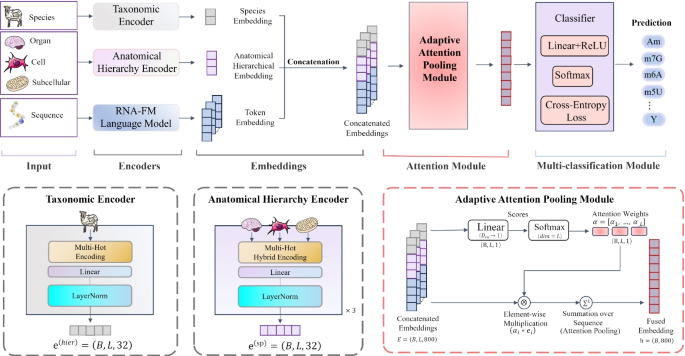
RNA modifications sit between sequence and function. EvoRMD integrates biological context with evolutionary RNA language models to predict modification sites interpretably, a step toward modeling how interventions on RNA propagate to cellular state.
03
Molecule · Understand / Predict
Learning molecular representations across complementary modalities
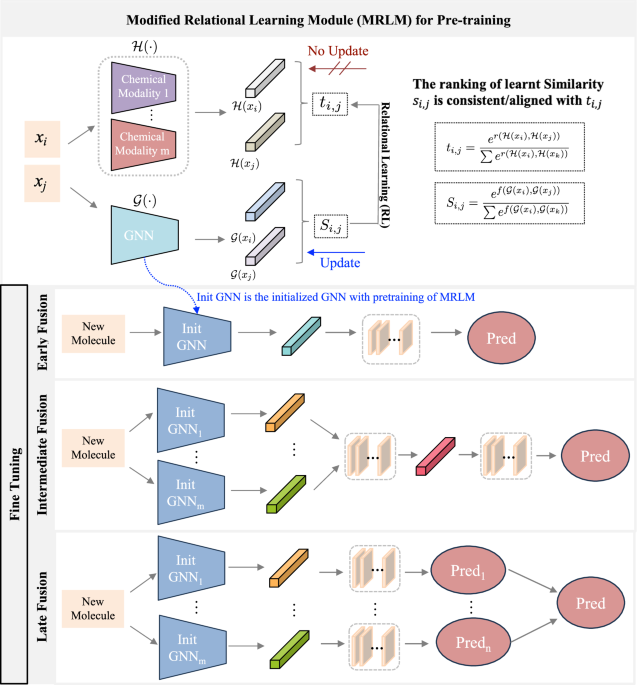
Chemical structure is observed through complementary views: graphs, spectra, text, and 3D geometry. Aligning them, asymmetrically and with relational learning, yields representations that transfer to property prediction and drug discovery while staying consistent with chemistry.
04
Molecule · Understand
Self-verifying structure elucidation from spectra
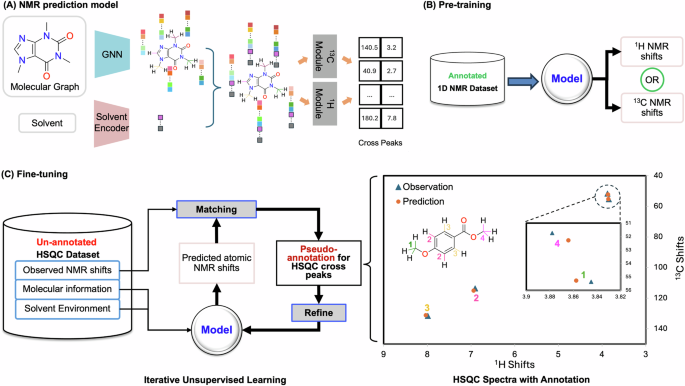
Determining a molecule's structure from its spectra is a problem where a model must be able to check its own answer. This line builds solvent-aware 2D NMR prediction, an annotated experimental benchmark, and reasoning-based elucidation from mass spectra, toward NMRScape: self-verifying structure determination.
05
Network · Understand / Intervene
From molecular interactions to disease networks and drug repurposing
Molecular interactions act through networks. Connecting binding and interactome structure to disease modules provides the route from a single intervention to a system-level response, and the basis for principled drug repurposing. Ongoing work builds affinity-weighted protein–protein interaction networks.
06
Methods · Trustworthiness
Foundation-model methods that stay reliable on scientific data
Scientific data are scarce and shift between experiments, so the foundation models behind these systems must adapt cheaply and remain grounded. This work studies which parameter directions matter during adaptation and how to keep multimodal models faithful to their inputs.
Open resources
Benchmarks, datasets, and models built around these questions
Outlook
Closing the loop from molecule to patient
Cellular perturbation response
Extend mechanistic, uncertainty-aware prediction to single-cell and Perturb-seq data, so that interventions learned at the molecular and network scales can be tested against measured cell states.
Precision intervention
Invert the models: identify the molecular interventions that move a biological system toward a desired state, with explicit uncertainty and experimental validation in the loop. At the patient scale, phenotype is the readout: a first step is predicting TP53 mutation status in hepatocellular carcinoma directly from MRI (BMC Med. Imaging 2025).
Foundations
Earlier work in cobalt-catalyzed asymmetric radical reactions and total synthesis (Chem 2024, Chem 2021) is the physical-organic foundation for building mechanism-aware models.